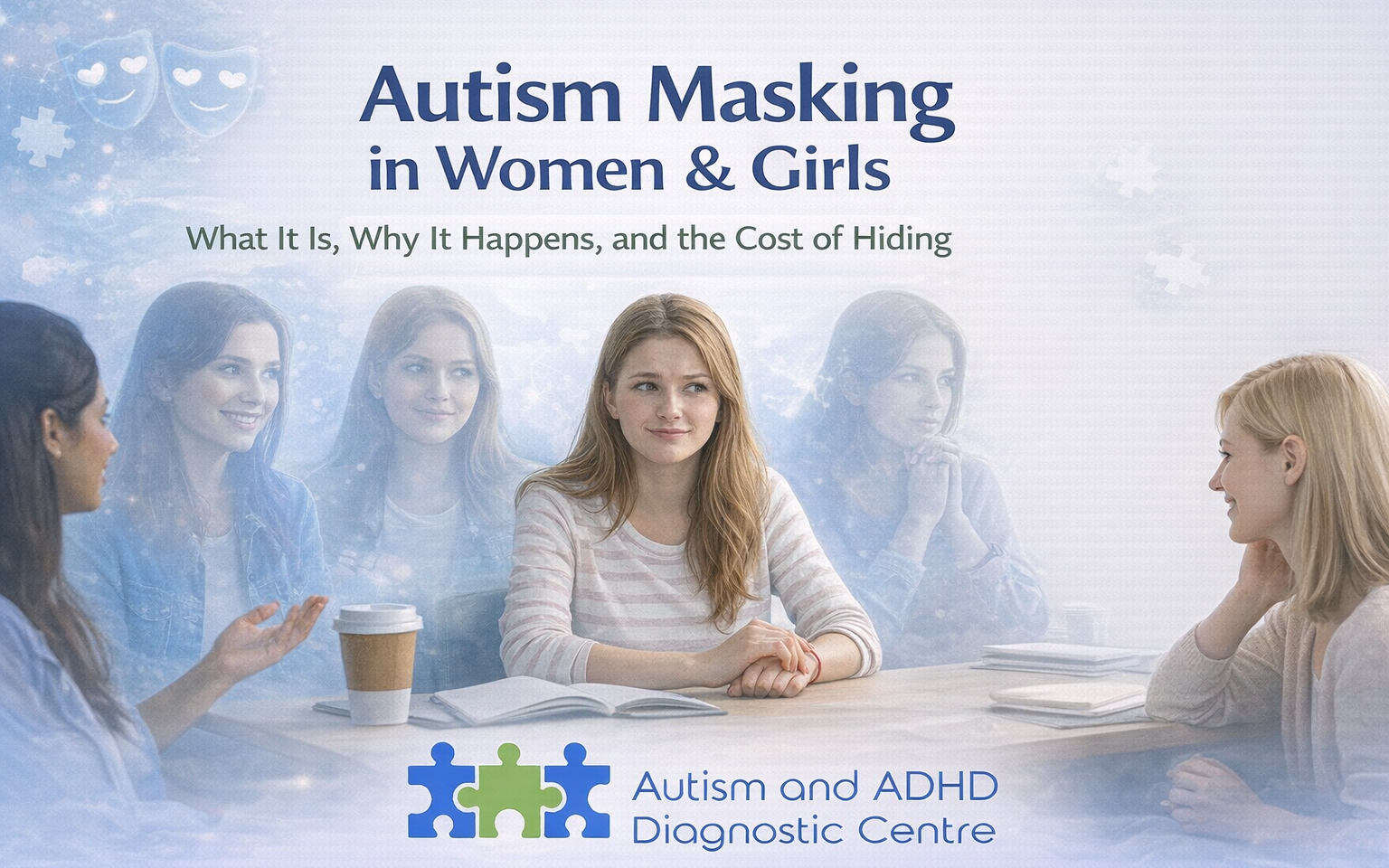
Autism Masking in Women and Girls: What It Is, Why It Happens, and the Cost of Hiding
Many autistic women and girls grow up being described as “coping well”, “quiet”, or “just anxious”.
At school or work, they may appear settled. At home, everything falls apart.
This difference is often explained by autism masking.
Masking can help someone get through the day.
Over time, it can also take a serious toll on mental health, identity, and access to the right support.
This guide explains what masking is, why it is more common in women and girls, what it looks like in daily life, and when it may be time to seek assessment or support.
What is autism masking?
Autism masking refers to the ways some autistic people hide, suppress, or compensate for autistic traits in social situations.
In research and clinical literature, this is often called:
- masking
- camouflaging
- social camouflaging
- compensatory strategies
- passing
- assimilation
Researchers use the term social camouflaging to describe the strategies autistic people use to appear more non-autistic in predominantly non-autistic environments.
This may involve copying social behaviour, suppressing natural responses, or constantly monitoring how one is perceived.
One widely used research tool is the Camouflaging Autistic Traits Questionnaire (CAT-Q).
It measures three patterns:
- Masking – presenting a non-autistic persona
- Compensation – using learned strategies to manage social situations
- Assimilation – blending in and hiding discomfort
Masking can be conscious or unconscious.
Many people do not realise they are doing it until later in life.
Why do autistic people mask?
Masking is not about attention seeking or trying to deceive others.
Research consistently describes it as a survival strategy.
Autistic people often mask to:
- avoid bullying, stigma, or rejection
- feel safer in social environments
- cope at school or work
- keep friendships or employment
- meet the expectations placed on them
Studies link higher levels of masking with experiences of being shamed, teased, or punished for autistic traits earlier in life.
For many, masking becomes automatic.
In adolescents, higher anxiety and stronger autistic traits are associated with increased camouflaging.
Although it may help in the short term, it often worsens mental health over time.
This is sometimes explained using a minority-stress framework.
When someone repeatedly has to suppress who they are to belong, the emotional cost builds.
Why masking is more common in women and girls
Research suggests that autistic women and girls are more likely to camouflage and are often diagnosed later than autistic boys and men.
Several factors contribute:
- Girls are often socialised to be polite, quiet, and accommodating
- Stereotypes about autism still focus on male presentations
- Diagnostic tools have historically been designed around boys
- Autistic traits in girls may look “socially acceptable” on the surface
As a result, autistic girls may appear to be managing, while internally struggling.
Many autistic women report receiving years of other mental health diagnoses, such as anxiety or depression, before autism is recognised.
Research now supports the idea of a female autism phenotype, where masking and more subtle traits contribute to missed or delayed diagnosis.
What masking can look like in daily life
Masking varies between individuals, but common examples include:
- copying facial expressions, gestures, or tone of voice
- forcing eye contact despite discomfort
- rehearsing conversations in advance
- scripting responses to common questions
- hiding or minimising stimming
- switching to quieter or less noticeable fidgeting
- copying peers’ interests, clothing, or slang
- closely watching others before responding
These behaviours align closely with how masking and assimilation are defined in the CAT-Q.
They are often exhausting to maintain.
“Fine at school, falling apart at home”
Many parents notice a sharp contrast between school and home behaviour.
The National Autistic Society highlights that masking can create a dichotomy:
- School reports suggest the child is coping
- Home behavior includes meltdowns, shutdowns, anxiety, or exhaustion
Holding everything together in a busy, unpredictable school environment requires immense effort.
Once home feels safe, the mask drops.
UK education charities also note that sensory demands such as noise, lighting, crowds, and constant transitions increase stress for autistic pupils, even when they appear calm.
This pattern is important and should never be dismissed.
The cost of masking
Mental health
Large studies of autistic adults show that higher camouflaging predicts higher anxiety, social anxiety, and depression, even when autistic traits are controlled for.
Recent research suggests the impact of camouflaging on mental health can outweigh the impact of autistic traits themselves.
The National Autistic Society also links higher masking to increased risk of suicidal thoughts and behaviours.
Autistic burnout
Autistic burnout is described as a state of long-term exhaustion, loss of function, and reduced tolerance to sensory input, caused by chronic stress and unmet support needs.
Masking contributes to cumulative load.
When expectations consistently exceed capacity, burnout becomes more likely.
Identity and authenticity
Autistic adults report that prolonged masking can lead to:
- loss of identity
- reduced sense of authenticity
- self-alienation
- lower self-esteem
Researchers caution against teaching masking as a goal, due to the risks to well-being and self-concept.
Delayed or missed diagnosis
Masking is recognised as a major barrier to autism diagnosis.
When children mask at school, professionals may underestimate difficulties and place blame on parents for behaviour seen only at home.
Studies of autistic women show significant delays in identification, often following years of other mental health labels.
Hearing from our clinicians
We asked one of our clinicians to speak about autism masking in women and girls and what they see in practice.
In this short video, they explain:
- why masking is so common
- how it affects mental health
- what parents and adults often miss
Supporting autistic people without increasing the need to mask
For autistic children, teens, and adults
Research on burnout and masking points to the importance of:
- reducing chronic stress
- adjusting expectations
- supporting authentic communication
Practical steps may include:
- protected recovery time after school or social demands
- permission to stim, rest, or withdraw
- identifying safe people and spaces where masking is not needed
For parents and carers
Guidance from the National Autistic Society encourages:
- viewing masking as a coping strategy, not misbehaviour
- advocating for environmental changes rather than behaviour suppression
- sharing detailed home observations with schools and clinicians
NICE guidance emphasises the importance of gathering information across settings.
For schools and education settings
Under the Equality Act 2010, autism is recognised as a disability.
Schools must make reasonable adjustments to prevent disadvantage.
Examples supported by UK guidance include:
- ear defenders or headphones
- quieter spaces
- predictable routines and visual timetables
- reducing sensory overload
- allowing appropriate stimming
- avoiding crowded transitions
Reducing environmental demands reduces the pressure to mask.
When to consider assessment or support
NICE guideline CG128 outlines when children and young people should be referred for autism assessment.
Indicators may include:
- long-term social communication differences
- sensory sensitivities
- repetitive behaviours or intense interests
- anxiety, shutdowns, or emotional exhaustion
- a large gap between public coping and private distress
If you recognise this pattern in yourself or your child, it is reasonable to speak to a professional about assessment or support.
Talk to a specialist who understands autism and masking
If this article reflects your own experience, or your child’s, you are not alone.
Many people contact us because they notice a difference between how someone appears to cope and how overwhelmed they feel beneath the surface.
At the Autism and ADHD Diagnostic Centre, our clinicians take time to understand the full picture across settings and talk through what support or assessment may be helpful.
We offer a free, no-obligation consultation with a member of our clinical team.
👉 Book a free consultation with our team
Frequently asked questions
1. Is masking always harmful?
Masking can help someone feel safer in the short term.
Problems arise when it becomes constant and unsupported.
2. Can someone mask without knowing it?
Yes. Many people only recognise masking later in life.
3. Do all autistic women mask?
No. Experiences vary widely. Masking is not universal.
4. Can masking affect diagnosis?
Yes. Masking is linked to delayed or missed diagnosis, especially in women and girls.
Sources and further reading
- Hull et al. Development and validation of the Camouflaging Autistic Traits Questionnaire (CAT-Q). Journal of Autism and Developmental Disorders.
- Hull et al. Gender differences in self-reported camouflaging. Autism.
- Cassidy et al. Camouflaging and suicidality. Journal of Autism and Developmental Disorders.
- Beck et al. Camouflaging and mental health in women. Autism.
- National Autistic Society. Masking and camouflaging guidance.
- NICE guideline CG128. Autism spectrum disorder in under-19s.
- Ambitious about Autism. Sensory differences and school environments.
- Cook et al. Camouflaging in autism: systematic review. Clinical Psychology Review.